How I work
Where the stakes are ambiguous and the decisions are expensive.
I turn customer evidence into product strategy when the stakes are high and the question is ambiguous. My work spans connected vehicles, EV commerce, and financial services—translating what customers need into roadmaps, metrics, and decisions that product teams can actually act on.
M.S. Human-Computer Interaction, Indiana University Indianapolis (4.0/4.0) ·
B.S. Psychology, University of Missouri (3.9/4.0)
Three commitments
-
I define the problem before I solve it
A brief is a starting hypothesis, not a fixed scope. Twice in the last two years the most valuable thing a study produced was a better question than the one it was handed, and in both cases that reframe changed what got built.
-
A finding is not yet a recommendation
It becomes one when it carries a support threshold, a visible counterexample, and a decision test a product team can actually apply and fail. Minority views stay in the deliverable rather than being averaged away, because the exception is usually where the design risk lives.
-
Org-wide alignment, not a handoff
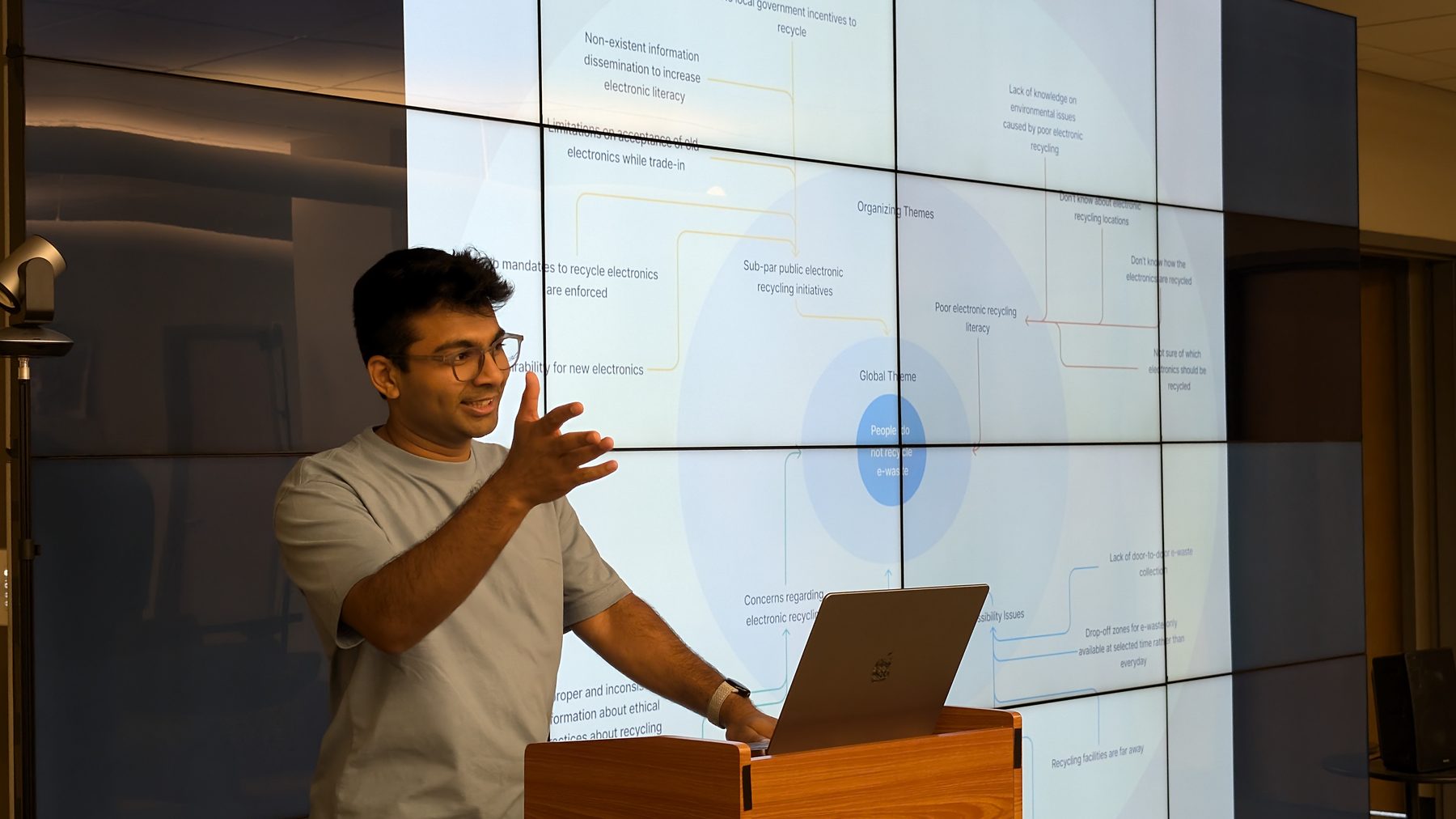
Research that stops at a report leaves the hard part to someone else. I run workshops, mentor the PMs and designers who build on my findings, and stay in the room through the decisions the research is supposed to inform.
Competencies
Experience & product strategy
- Product discovery
- Opportunity prioritization
- Customer journey mapping
- Experience strategy
- Product roadmaps
- UX metrics
- Stakeholder management
- Workshop facilitation
- Executive communication
Research methods
- Foundational & generative research
- Evaluative research
- Mixed methods
- Semi-structured interviews
- Surveys
- Moderated & unmoderated usability testing
- Contextual observation
- Voice of Customer
- Heuristic evaluation
- Cognitive walkthroughs
- Prototype testing
- Card sorting
- Tree testing
- A/B testing
Analysis & measurement
- Thematic analysis
- Inductive & deductive coding
- Affinity mapping
- Evidence matrices
- Mixed-method triangulation
- Task success
- Error rate
- Time on task
- System Usability Scale
- Chi-square tests
- T-tests
- ANOVA
Tools
- Condens
- UserZoom
- Qualtrics
- Dscout
- User Interviews
- Figma
- FigJam
- ATLAS.ti
- R
- SPSS
- Otter.ai
- ChatGPT
Where the evidence habit came from
Four years of developmental research at the University of Missouri, on one question: how do people build expectations about how they will be treated, and what would it take to measure one? Three studies — N400 event-related potentials in mothers, a longitudinal looking-time study across 39 families, and an infant study I designed and rebuilt for remote testing mid-pandemic — then a CSCW lab in Indianapolis working on caregiving coordination for families in cancer treatment.
Open to conversations
If you are trying to work out which question your team should actually be asking — and what it would take to get product, engineering, and business aligned on the answer — that is the conversation I want to be in.